Learning how to choose a dock plate according to your requirements, can make a significant difference to safety, speed and day-to-day operations within your loading bay. Whether you’re bridging the gap between a dock and a trailer or streamlining manual handling across different loading heights, the right dock plate helps protect both personnel and goods.
We’ve supplied dock plates across every kind of loading scenario, from busy courier depots and warehouses to distribution centres and small goods yards. So what should you consider when selecting a dock plate, dock ramp or dock board?
-
Understand the Application of a Dock Plate
Begin by determining exactly how the dock plate will be deployed. Is it for pedestrian use, manual handling equipment such as pallet trucks, or occasional forklift traffic? Dock plates are designed to handle light-to-medium loads, not the high-impact strain of forklifts – for that, a dock board may be more suitable.
If you’re bridging a small gap between similar heights and don’t require curbs or locking legs, a dock plate is likely the right fit.
-
Know Your Load Requirements
Each dock plate has a rated capacity. It’s important when evaluating how to choose a dock plate to consider not just the weight of the load, but the combined weight of the handling equipment and the operator. If you’re using a hand pallet truck to move a 600kg pallet, you’ll need to factor in the truck weight and the operator, too.
For added peace of mind, many businesses opt for a capacity slightly above their regular load to ensure safe performance under variable conditions.
-
Check the Width of Your Loading Area
Your dock plate should be wider than the equipment being used – in accordance with the Dock Leveller standard, the minimum width should be 700mm wider than the track width of the equipment being used, unless restricted by your loading facilities and measures are taken to prevent the operator and equipment from falling. We also typically have at least 150mm (6”) wider on each side than the widest load. This ensures safe manoeuvrability and reduces the risk of falling from the edge.
If you’re dealing with unusually wide pallets or goods, check whether a custom-width plate is necessary.
-
Consider the Height Differential
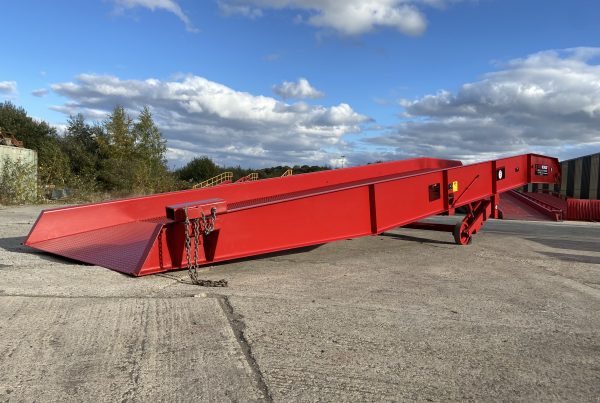
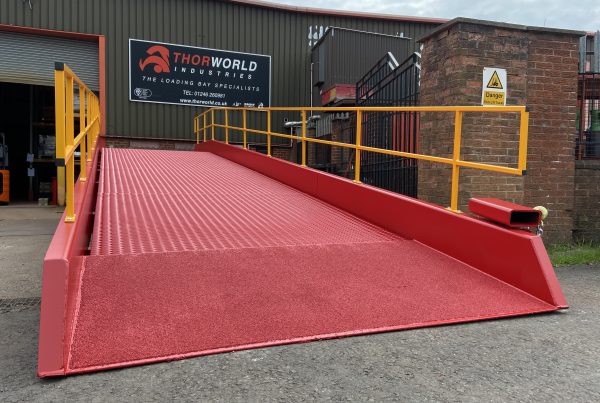
The greater the difference in height between the dock and the vehicle, the more carefully the plate must be specified. Dock plates come with bend angles to allow a smooth transition, but larger height variations may require a longer plate, or even an alternative solution like a two-stage Dockplate ramp, or even a yard ramp.
Measure the typical height difference you’re working with and speak to a supplier who can recommend a suitable length configuration.
-
Choose the Right Material for the Dock Plate
Our dock plates are manufactured in a specialist high-grade aluminium for easy portability and corrosion resistance, and excellent strength-to-weight, making them ideal for manual use. Some manufacturers use steel plates, but they will generally be weaker and heavier.
-
Dock Plate Safety Features Matter
When deciding how to choose a dock plate, look for dock plates with non-slip tread surfaces, carry handles, and fixed stops or legs to prevent movement during use. Even with low-weight handling, a shifting dock plate can present a serious hazard, especially in fast-paced environments.
Each dock plate comes with a pair of locking legs, which locate in the gap between the vehicle and loading dock, and prevent the plate from slipping out of position. If the gap is greater than 150mm then there is a risk the plate can move and fall, therefore, a second set of locking legs is recommended. Our technical team can provide further assistance in specifying this option if required.
Additional side-curbs with castors are also available to suit our range of dock plates. The curbs can act as guides to prevent goods from falling from the plate but beware that they do make the useable width slightly narrower. The cast wheels fitted to these curbs also allow the dock plate to be lifted up on one side, and pushed around, rather than needing to be carried.
-
Movement and positioning
Standard dock plates come with either cut-out handles or bolted-on carrying grips for easy retrieval. For larger/heavier plates, we recommend the use of our fork truck lifting handles, which allow the dock plate to be lifted and positioned by fork lift truck.
Talk to Thorworld
If you’re still unsure how to choose a dock plate for your business, we’re here to help. Thorworld supplies a full range of dock plates and boards, including custom sizes, and can advise on the best fit based on your operational requirements.
Visit our Dock Plates and Boards page for more information, or get in touch with us to speak to our team.